Pet Food Recall Procedure for Pet Stores: A Practical Guide
A pet food recall can turn an ordinary retail shift into a product-tracing exercise. This practical procedure helps small pet stores act quickly without alarming customers or removing unaffected stock.
In this article
It is Saturday morning, and a customer walks to the counter holding a bag of dog food.
“I saw this brand was recalled. Is this bag safe?”
The store is busy. A delivery is waiting by the back door, another customer needs help choosing a harness, and the employee at the register has seen the same social-media post—but not the official recall notice.
The brand matches. The recipe might match. Nobody has checked the lot number.
That is the uncomfortable reality of a pet food recall: the first alert may arrive through a customer rather than your supplier, and the product name alone rarely tells you everything you need to know.
A reliable pet food recall procedure helps a small store answer four urgent questions:
- Is the product actually affected?
- How much affected stock do we have?
- Has any of it already been sold?
- What must staff and customers do next?
The procedure does not need to be complicated. It does need to exist before the phone starts ringing.
Why “remove that brand” is not a recall plan
Recalls frequently apply to particular products, package sizes, production lots, expiration dates, or distribution areas—not every item carrying the manufacturer’s name.
Removing an entire brand without checking the notice could create unnecessary losses and concern. Leaving an affected variation on the shelf because its packaging looks slightly different is the more serious risk.
The FDA explains that recalls are actions taken by a firm to remove a product from the market. They may begin voluntarily, at the FDA’s request, or under FDA order where statutory authority applies. The FDA maintains a dedicated animal and veterinary recalls list, alongside its broader recalls and safety-alert database.
Your store’s role is operational: identify the exact product, stop it from being sold, follow the recall instructions, and help customers obtain accurate information.
Give the recall to one person—and a backup
When responsibility belongs to “the team,” important steps can easily be duplicated or missed.
Name a recall coordinator and backup. In a small store, this may be the owner, manager, or inventory lead.
The coordinator should be responsible for:
- Confirming notices with an official or supplier source
- Recording the affected product identifiers
- Searching store inventory
- Placing stock in quarantine
- Disabling or flagging the item at checkout
- Coordinating customer communication
- Managing returns and supplier credits
- Keeping a record of every action
- Approving when the product can be sold again
The backup needs access to the same supplier contacts, inventory records, passwords, and storage areas. A recall should not stall because the owner is off-site.
Subscribe to FDA recall notifications and maintain current email contacts for manufacturers and distributors. The FDA’s general recall page offers an email subscription for recall and safety alerts.
Confirm the notice before taking action
A screenshot, forwarded message, or shortened social post is an alert to investigate—not the final instruction.
Locate the manufacturer, distributor, or FDA notice and record:
- Brand name
- Exact product name and recipe
- Species and life stage, if stated
- Package size
- UPC or barcode
- Lot or production code
- Best-by or expiration date
- Distribution area
- Reason for the recall
- Date of the notice
- Instructions for retailers
- Instructions for consumers
- Manufacturer contact details
- Link or saved copy of the notice
Check the notice for updates. An initial recall can be expanded to include additional products or lots.
Give the incident a simple reference, such as RECALL-2026-04, and keep all notes, emails, photographs, stock counts, and customer messages together.
Match the product using more than its name
Suppose the notice names “Chicken Recipe Dog Food.” Your shelves contain three bag sizes, two package designs, and stock from different deliveries.
Do not rely on color, flavor, or product name alone.
Match every available identifier:
- UPC
- Package size
- Lot number
- Best-by or expiration date
- Product description
- Manufacturer information
The FDA says lot numbers are particularly important because they can help identify the manufacturing plant and production date. They are commonly printed near the best-by, best-before, or expiration date. FDA complaint guidance also identifies the UPC, net weight, storage requirements, purchase location, and exact product description as useful evidence.
Inspect all possible locations:
- Sales shelves
- Stockroom
- Receiving area
- End displays
- Checkout displays
- Online-order staging shelves
- Returns area
- Grooming or boarding supply cupboards
- Company vehicles
- Other branches or warehouses
Two employees should verify the count when practical. Record affected units separately from similar but unaffected units.
Quarantine first, discuss disposal later
As soon as affected stock is identified, move it away from sellable inventory.
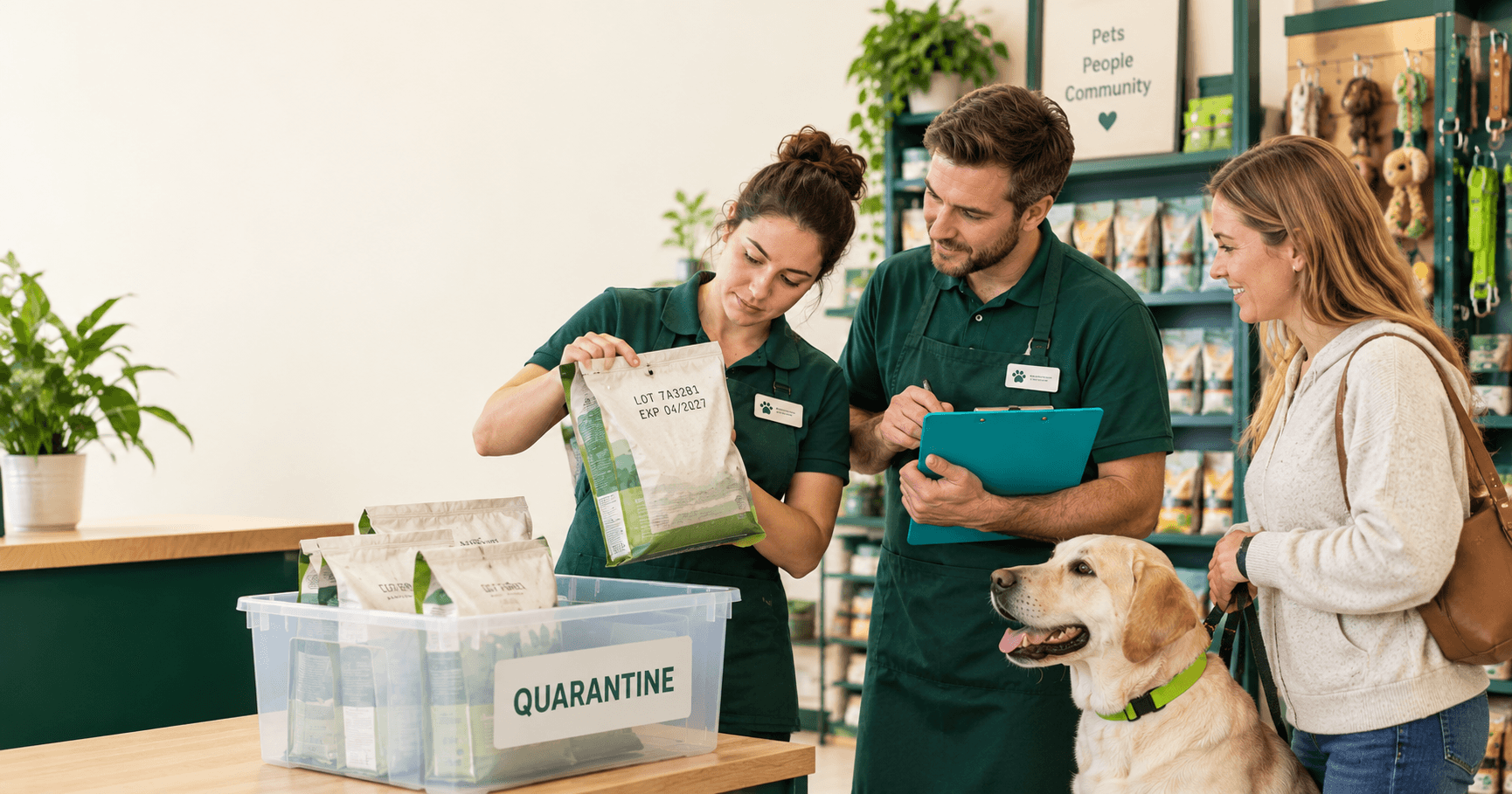
Use a defined quarantine location that customers cannot access. Mark the products clearly:
DO NOT SELL — RECALL HOLD
Recall reference:
Date quarantined:
Employee initials:
Do not place recalled food in the normal returns pile. A busy employee could accidentally restock it.
Unless the official instructions require immediate disposal, keep the products secure while confirming what the manufacturer or distributor wants you to do. The business may need product counts, photographs, proof of purchase, or specific packaging information before issuing credit.
Record every movement. Your log should show:
- Quantity found
- Quantity quarantined
- Storage location
- Quantity returned or destroyed
- Date of disposition
- Person who completed the action
- Supplier credit or replacement reference
If destruction is required, follow the recall notice and applicable local waste rules. Do not donate, discount, sample, or privately give away recalled products.
Stop the sale at every checkout point
Removing bags from the shelf is not enough if the product can still be ordered online or found in another location.
Check every sales channel:
- Main register
- Secondary checkout devices
- Online store
- Click-and-collect inventory
- Subscription or repeat-order lists
- Marketplace listings
- Grooming and boarding add-ons
- Other branches
Mark the affected item as unavailable or blocked wherever possible. Add a register note telling employees to contact the manager if someone attempts to buy or return it.
Be careful with broad SKU blocks. If several lots share one barcode, stopping the whole SKU temporarily may be the safest short-term action while the team checks individual packages. Once unaffected lots are verified, the store can decide whether to restore them for sale.
Work out which customers may have bought it
This is where everyday transaction records become part of product safety.
Search the affected product’s sales history for the relevant period. Depending on the information available, you may be able to identify:
- Sale date and time
- Quantity sold
- Receipt or transaction number
- Customer account
- Loyalty-program member
- Online-order customer
- Subscription customer
- Branch where the sale occurred
A transaction record may prove that an item was sold without identifying the buyer, particularly for anonymous in-store purchases. Record that limitation rather than pretending every unit is traceable.
For customers you can identify, prepare a focused notification. Do not send a vague “pet food recall” warning to your entire database if the affected product and purchasers are known.
Follow applicable privacy and communication rules, and use customer information for the safety purpose for which it is reasonably needed.
Write a customer message that answers the immediate questions
Customers need clarity, not promotional language.
A recall notification should explain:
- What product is affected
- Which package size, UPC, lot, or date applies
- Why it is being recalled
- What the customer should do with it
- Whether it can be returned
- Where to find the identifying code
- Who to contact with product questions
- Where the official recall notice can be read
- What to do if a pet appears unwell
Example:
We are contacting you because our records indicate that you may have purchased [exact product] from us on [date]. The manufacturer has recalled specific packages with [lot/date/UPC] because of [reason stated in notice]. Please stop using an affected package and follow the manufacturer’s return or disposal instructions here: [official link]. If your pet appears unwell, contact your veterinarian. You may also call us at [number] for help checking the package details.
Do not diagnose symptoms or promise that a product is safe when its identifying code cannot be confirmed. Direct health concerns to a veterinarian and product-specific questions to the official recall contact.
Keep a copy of the final message and record when and how it was sent.
Make returns calm and consistent
Staff should know how to respond when a customer arrives worried or angry.
Prepare a short front-desk instruction covering:
- How to verify the affected product
- Whether a receipt is required
- Refund, replacement, or credit options authorized by the recall
- Where returned packages must be placed
- What information should be recorded
- When a manager is required
- How to handle partially used or leaking packages
Do not open recalled packages at the counter. Place returned products directly into the designated quarantine container or area.
Customers may no longer have their receipt. Decide in advance what alternative evidence you will accept, such as a transaction lookup or customer-account history, while following the manufacturer’s reimbursement terms.
Help preserve useful complaint information
A recall may begin with reports from pet owners, veterinarians, or retailers. Your store could receive a complaint before any public notice exists.
If a customer reports unusual odor, discoloration, swelling, leakage, a foreign object, or possible illness, gather facts without asserting that the food caused the problem.
Ask the customer to retain:
- Original packaging
- Lot and date codes
- UPC
- Remaining product
- Receipt or purchase information
- Photographs
- Storage and handling details
- Veterinary records, where relevant
FDA guidance specifically recommends keeping original packaging because it can contain information needed to identify the product variety, plant, and production date. Consumers can submit reports through the FDA Safety Reporting Portal using the agency’s pet food complaint guidance.
Your employee should record the complaint and notify management even if only one customer has reported an issue.
Run a recall drill before a real alert arrives
Choose one stocked product and conduct a tabletop exercise without removing it from sale.
Ask the team to:
- Find its SKU and supplier.
- Locate every unit in the building.
- Read the lot and best-by codes.
- Find its recent transactions.
- Draft a customer notification.
- Identify the quarantine area.
- Locate the supplier’s recall contact.
- Record the simulated response.
Time the exercise. Then note where the process slowed down.
Perhaps lot numbers are difficult to read. Stock from different deliveries may have been mixed. Supplier contacts may exist only in one employee’s inbox. Online and in-store product names may not match.
A 20-minute drill can expose those weaknesses without a worried customer waiting at the counter.
Pet food recall action plan
Prepare now
- Appoint a recall coordinator and backup
- Subscribe to FDA recall alerts
- Maintain manufacturer and distributor contacts
- Create a recall record template
- Designate a secure quarantine area
- Write customer and staff message templates
- Confirm how sales history can be searched
- Run a tabletop exercise
When an alert arrives
- Verify it through an official or supplier source
- Record all affected product identifiers
- Search every stock location
- Quarantine matching products
- Block affected items across sales channels
- Count and photograph the stock
- Search recent transactions
- Brief all employees
- Notify identifiable purchasers
- Follow supplier disposition instructions
Before closing the incident
- Reconcile returned, destroyed, and credited units
- Save supplier correspondence
- Record customer contacts and complaints
- Confirm whether the recall was expanded
- Obtain authorization before restoring sales
- Review what delayed the response
- Update the written procedure
Fast action depends on ordinary records
A recall plan is built long before a recall appears.
Clear product records make stock easier to locate. Consistent checkout records make past sales easier to investigate. Organized supplier information reduces time spent searching through emails. Trained employees know that an affected bag belongs in quarantine—not behind the counter with an uncertain sticky note.
The objective is not to create panic every time a brand appears online. It is to replace guesswork with a controlled process: verify, identify, isolate, trace, communicate, and document.
Customers may never see most of that work. They will notice when your store can calmly help them determine whether their pet’s food is affected.
Keep product and transaction records organized
GoPet AI’s pet-care POS system provides real-time inventory tracking, product-level sales information, expiry-date tracking, customer records, and refunds for pet retailers.
It does not replace official recall notices or a written safety procedure. Used alongside a store’s lot-checking and quarantine process, organized inventory and transaction records can make it easier to understand what is in stock and what has been sold.
Sources
About the author
Jeremy
Petcare Sales Manager
Passionate about helping pet businesses thrive through technology and innovation.
Ready to streamline your pet care business?
Join thousands of groomers, boarding facilities, daycare centres, and vet clinics using GoPet AI to manage bookings, CRM, POS, and invoicing — all in one place.
- ✓Online booking & scheduling
- ✓Invoicing, POS & payments
- ✓CRM & client management
- ✓Staff, loyalty & analytics
Setup in under 2 minutes · Cancel anytime