Building a Winning Pet Business Loyalty Program for Client Retention
Learn the secrets to creating a pet business loyalty program that boosts client retention, increases visit frequency, and turns one-time customers into lifelong advocates for your brand.
In this article
Why Client Retention Is the Most Profitable Investment a Pet Business Can Make
Acquiring a new customer costs five times more than retaining an existing one. For pet grooming salons, boarding facilities, daycare centers, and veterinary clinics, this statistic translates directly into business strategy: the clients you keep are worth far more than the clients you chase.
Yet most pet businesses invest the bulk of their marketing budget on acquisition, running promotions and ads to attract new faces, while letting loyal regulars drift away quietly. A well-designed loyalty program reverses that dynamic entirely. It makes your best clients feel genuinely valued, gives them a concrete reason to return more often, and turns them into enthusiastic advocates who refer their friends, family, and neighbors.
This guide walks you through how to build a pet business loyalty program that actually works, backed by smart Pet CRM automation and the tools available through GoPet AI.
Step 1: Understand What Your Clients Actually Value
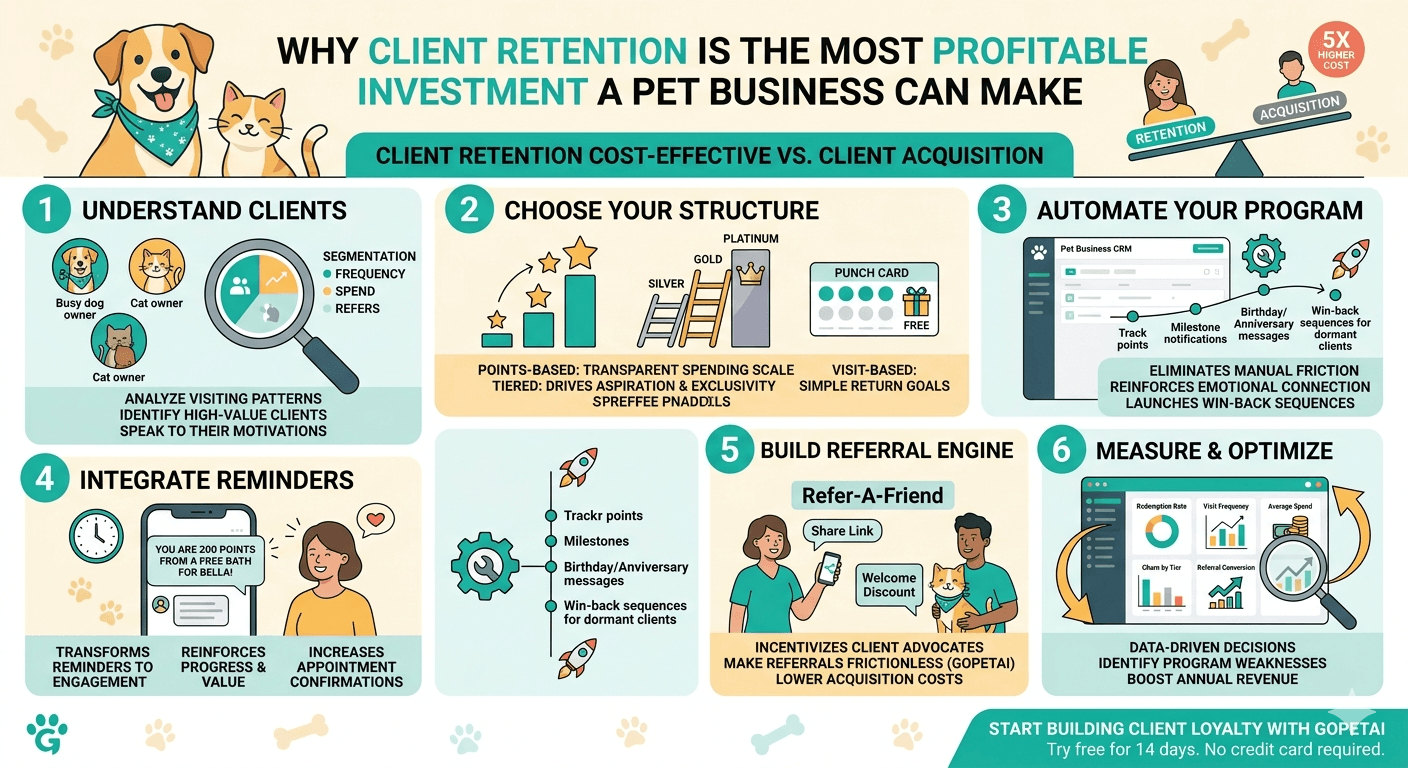
Before you design any loyalty structure, spend time understanding what motivates your specific client base. Pet owners are not a monolithic group. A busy professional who boards their dog every weekend has different motivations from a retiree who brings her cat in for monthly grooming. The most effective loyalty programs are built around real client behavior, not assumptions.
Start by analyzing your existing data. Which clients visit most frequently? Which ones spend the most per visit? Which ones refer the most new clients? Which ones have not come back in 60 days or more? A dog grooming CRM like GoPet AI surfaces this segmentation automatically, giving you a clear picture of who your most valuable clients are and what their visit patterns look like before you build a single reward tier.
Common motivators for pet business clients include: monetary savings (discounts and free services), recognition and status (VIP treatment, priority booking), convenience (dedicated booking lines, faster check-in), and emotional connection (personalized pet birthday messages, care notes shared after each visit). Your loyalty program should speak to the motivators that resonate most with your highest-value segments.
Step 2: Choose the Right Loyalty Structure for Your Business
There is no single best loyalty structure. The right choice depends on your business model, average ticket size, and how often clients visit. Here are the three most effective models for pet businesses.
Points-based systems are the most widely used and understood. Clients earn points for every dollar spent and redeem them for discounts, free services, or merchandise. The appeal is transparency: clients always know exactly where they stand and how close they are to their next reward. Points systems work especially well for businesses with a wide range of service prices, because they naturally scale rewards to spending level.
Tiered programs create aspiration and exclusivity. Silver, Gold, and Platinum clients receive progressively more valuable perks: priority scheduling, complimentary add-ons, exclusive access to new services before the general public, or a dedicated point of contact for bookings. Tiered programs drive long-term retention because clients actively work to maintain or upgrade their status. The key is to make the jump from one tier to the next feel achievable but not trivial.
Visit-based or punch card programs are simple, immediately understandable, and beloved by loyal local businesses. Every fifth groom free, or a complimentary bath after ten visits, creates a clear goal that motivates return visits without requiring complex tracking. With the right pet loyalty program software, punch card mechanics can be digitized and automated, eliminating the friction of physical cards.
For most small and mid-sized pet businesses, a hybrid approach works best: points that accumulate toward tier status, with tier-specific perks layered on top. This gives clients both short-term rewards and long-term goals to work toward simultaneously.
Step 3: Automate Your Program With Pet Business CRM Software
The single biggest mistake pet business owners make with loyalty programs is trying to run them manually. Spreadsheets, paper punch cards, and memory-based systems leak revenue because they require perfect execution from already-stretched staff. They do not scale beyond a certain point, and they create inconsistent client experiences that undermine the program's purpose.
Automating your loyalty program through a pet business CRM removes all of that friction. Here is what automation handles for you.
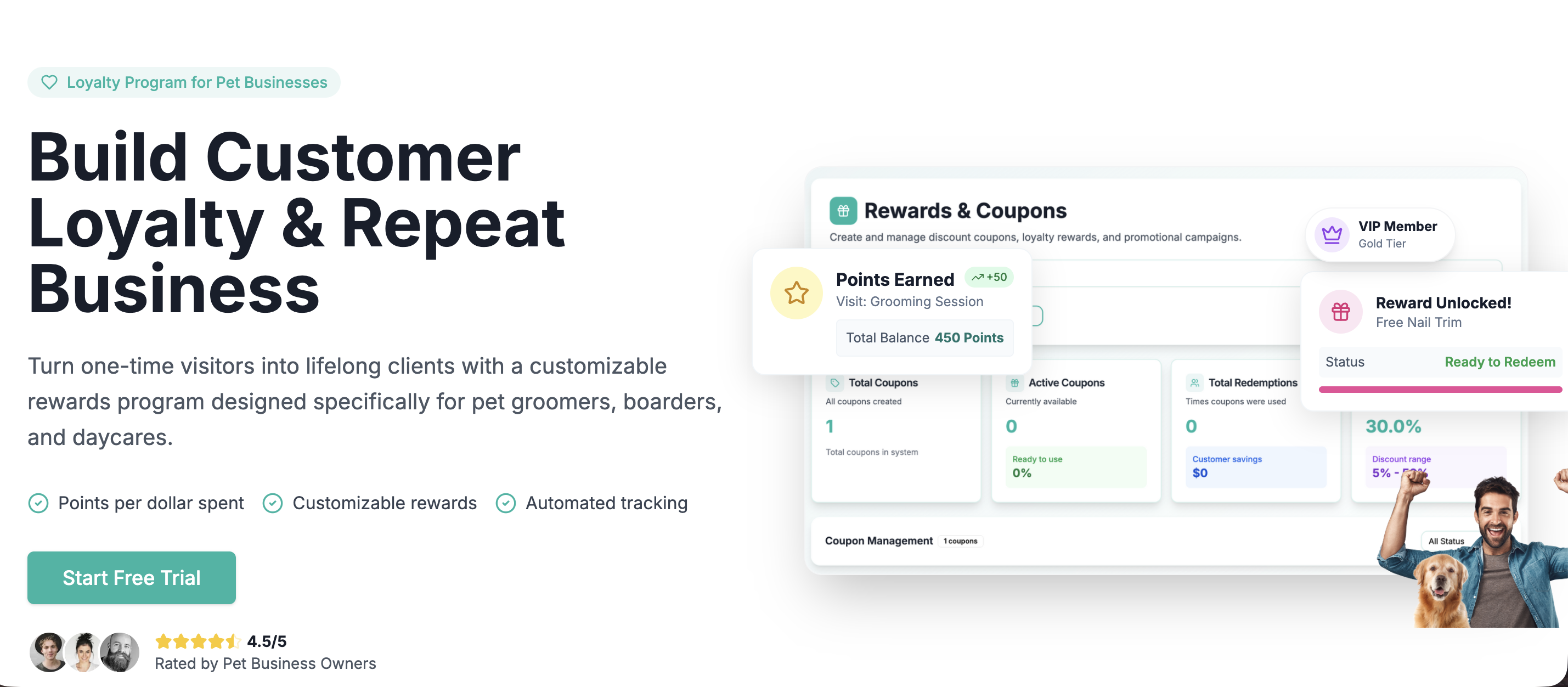
Points tracking updates automatically after every completed service or purchase, with no manual data entry required. Clients receive an instant message after each visit confirming their new balance and showing how close they are to their next reward, a small but powerful touchpoint that keeps the program top of mind.
Milestone notifications go out automatically when a client crosses a threshold: reaching Gold tier status, earning their first free service, or hitting a lifetime spend milestone. These messages feel personal and celebratory, which reinforces the emotional connection between your brand and your client.
Birthday and anniversary campaigns trigger automatically based on client and pet data. A simple message on a pet's birthday, maybe with a small discount on their next grooming appointment, generates outsized goodwill for a minimal cost. Clients remember how you made them feel, and these small gestures build the kind of loyalty that no competitor discount can easily disrupt.
Win-back sequences launch automatically when a client has not visited in a defined period, typically 45 to 60 days for a grooming salon or 90 days for a boarding facility. These sequences include a personalized message acknowledging the gap and a compelling reason to return, whether a loyalty bonus, a limited-time offer, or simply a warm check-in asking how their pet is doing.
Step 4: Integrate Loyalty With Your Appointment Reminder System
One of the most underutilized opportunities in pet business loyalty programs is connecting them to appointment reminders. Most businesses treat reminders as a purely operational tool: send a message, reduce no-shows, done. But reminders are actually a loyalty touchpoint in disguise.
When a reminder message includes the client's current loyalty points balance and a note like "You are just 200 points away from a free bath for Bella," it transforms a transactional notification into an engagement moment. The client is reminded both of their upcoming appointment and of the progress they are making in the program. This subtle reinforcement increases both confirmation rates and emotional investment in the relationship.
GoPet AI's automatic reminders for pet appointments integrate directly with loyalty data, so every reminder touchpoint can carry relevant, personalized loyalty information. This kind of tight integration between CRM and operational tools is what separates a loyalty program that runs in the background from one that clients actively notice and appreciate.
Step 5: Build a Referral Engine Into Your Loyalty Program
Word of mouth is still the highest-converting source of new clients for most local pet businesses. A structured referral component in your loyalty program turns your satisfied clients into an active sales force.
The mechanics are straightforward: when a loyalty member refers a new client who completes their first appointment, both the referrer and the new client receive a reward. The referrer gets bonus points or a free add-on. The new client gets a welcome discount on their first service. Everyone wins, and your acquisition cost for that new client drops dramatically compared to paid advertising.
The critical piece is making the referral process frictionless. If a client has to remember a code, fill out a form, or navigate a complicated process, most of them simply will not bother. The pet parent portal in GoPet AI gives each client a personal referral link they can share in one tap, and the system automatically tracks, attributes, and rewards referrals without any manual follow-up from your team.
Step 6: Measure What Matters and Optimize Continuously
A loyalty program that is not measured is not managed. The following metrics tell you whether your program is working and where to improve it.
Redemption rate measures how often clients actually use their accumulated points or rewards. A low redemption rate typically means one of two things: either clients are not aware of how to redeem, or the rewards are not compelling enough to motivate action. Both are fixable once identified.
Visit frequency change compares how often loyalty members visit versus non-members, and whether membership is associated with an increase in visit frequency over time. This is the clearest evidence that your program is achieving its primary goal.
Average spend per visit tracks whether loyalty members are spending more per appointment than non-members. A well-designed points system should naturally incentivize modest upsells because clients want to accelerate their progress toward the next reward.
Churn rate by tier reveals which segments of your loyalty program are retaining clients most effectively and which are losing them. If Gold members are churning at a higher rate than Silver members, that is a signal that your Gold perks are not delivering enough perceived value.
Referral conversion rate shows how many loyalty members are actively referring new clients and how many of those referrals are converting to paying clients. This metric connects your retention investment directly to new revenue generation.
GoPet AI surfaces all of these metrics automatically in the analytics dashboard, so you can review program performance in minutes rather than hours and make data-driven adjustments every month.
What a High-Performing Pet Loyalty Program Looks Like in Practice
Consider a mid-sized grooming salon with 400 active clients. Before implementing a loyalty program and CRM automation, average visit frequency is 6.5 times per year per client. After launching a tiered points program with automated milestone messages, win-back sequences, and integrated appointment reminders, the salon sees average visit frequency climb to 8.2 times per year. For 400 clients at an average ticket of $75, that is an additional $51,000 in annual revenue with no new client acquisition cost.
This kind of compounding effect is exactly why investing in client retention consistently outperforms investing in acquisition for established pet businesses.
Also read: Cash Flow Management for Pet Care Businesses: Survive Crunches and Build Long-Term Stability
Start Building Client Loyalty With GoPet AI
GoPet AI's all-in-one pet business platform includes everything you need to launch and automate a high-performing loyalty program: CRM and client segmentation, automated points tracking and milestone notifications, pet parent portal with personal referral links, integrated appointment reminders with loyalty data, and a full analytics dashboard to measure program performance.
Your clients love their pets. Build a loyalty program that shows you love serving them, and watch your retention rates, average spend, and referral volume all grow month over month.
Try GoPet AI free for 14 days. No credit card required.
About the author
Jeremy
Petcare Sales Manager
Passionate about helping pet businesses thrive through technology and innovation.
Ready to streamline your pet care business?
Join thousands of groomers, boarding facilities, daycare centres, and vet clinics using GoPet AI to manage bookings, CRM, POS, and invoicing — all in one place.
- ✓Online booking & scheduling
- ✓Invoicing, POS & payments
- ✓CRM & client management
- ✓Staff, loyalty & analytics
Setup in under 2 minutes · Cancel anytime