Loyalty Cards, Referral Programs, Coupons and Gift Certificates: The Pet Business Guide to Repeat Sales and New Clients
Loyalty cards, referral programs, coupons, and gift certificates are four of the most cost-effective tools a pet business can use to drive repeat bookings, attract new clients, and grow revenue without heavy ad spend. This guide shows you exactly how to design and run each one profitably.

In this article
Why Retention and Referral Are the Most Profitable Marketing Channels for Pet Businesses
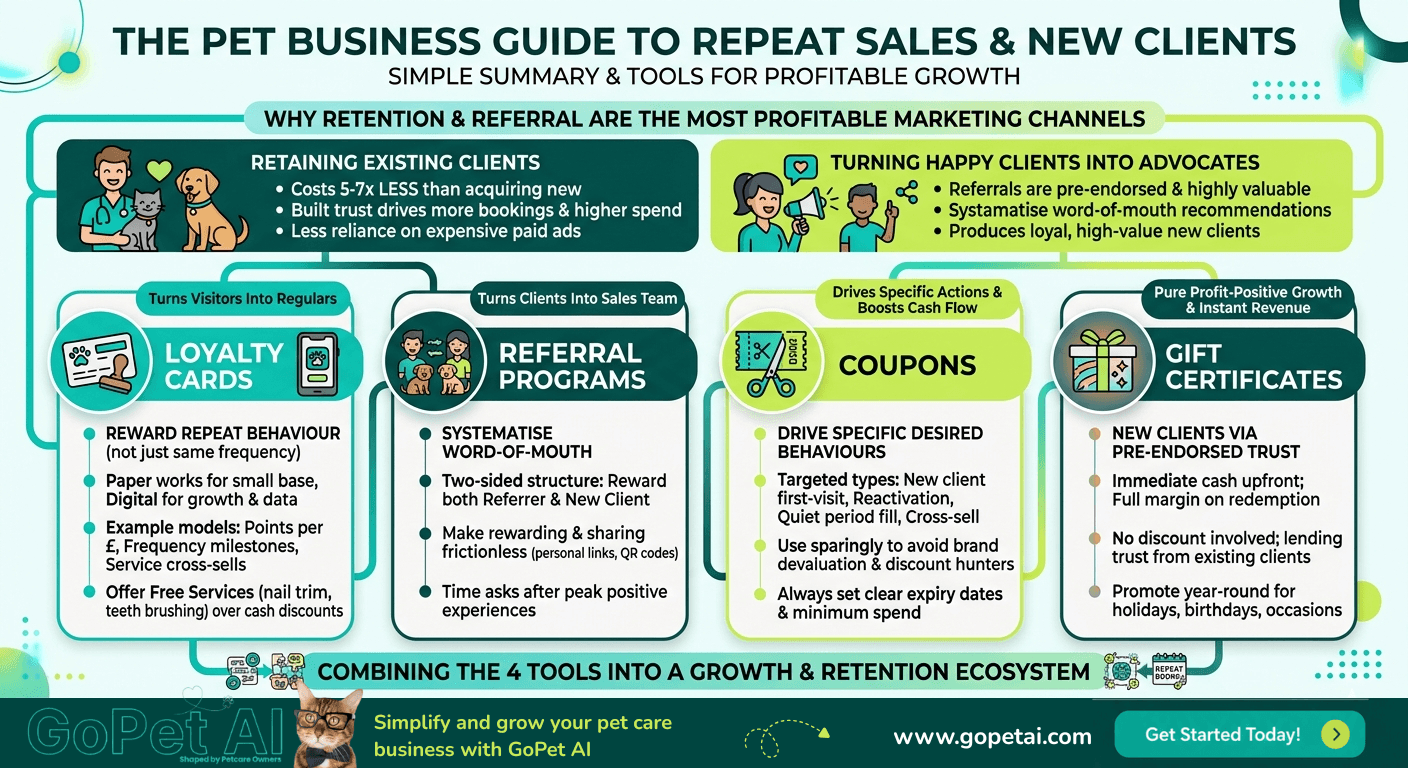
Acquiring a new client costs five to seven times more than retaining an existing one. For pet businesses — where trust, routine, and emotional attachment drive purchasing decisions — this gap is even wider. A client who already trusts you with their dog or cat is far more likely to book again, spend more per visit, and recommend you to their friends than any cold prospect you reach through paid advertising.
Loyalty cards, referral programs, coupons, and gift certificates are four tools that directly exploit this dynamic. Each one serves a slightly different purpose: loyalty cards reward and reinforce repeat behaviour; referral programs turn satisfied clients into active advocates; coupons drive specific actions at specific moments; gift certificates bring new people through your door with zero friction and no hard sell.
Used well, these four tools work together as a retention and growth engine that costs a fraction of paid advertising — and produces clients who are far more loyal and valuable. Used poorly, they erode margins, attract the wrong clients, and create administrative headaches. This guide shows you how to do each one right.
Loyalty Cards: Turning One-Time Visitors Into Regulars
A loyalty card is one of the simplest and most psychologically powerful retention tools available. The premise is simple: visit a certain number of times or spend a certain amount, and earn a reward. But the mechanics underneath — and whether they actually work — depend entirely on how you design them.
The Paper Punch Card: Still Works, But Has Limitations
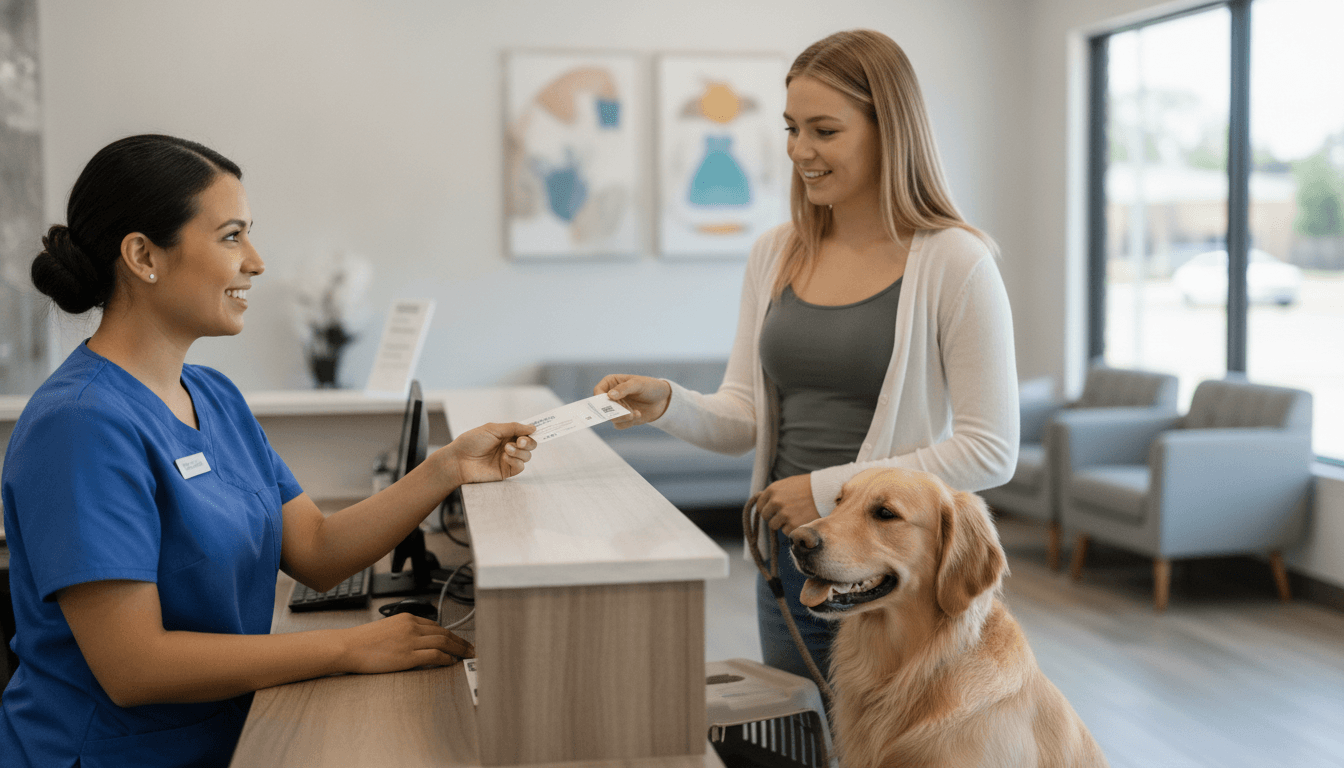
The classic paper punch card — "Buy 9 grooms, get your 10th free" — has been a pet business staple for decades. It works because it's tangible, simple, and gives clients a visible sense of progress toward a goal. The endowment effect means clients who have already received 5 punches on a card feel committed to finishing it, even if they might otherwise consider trying a competitor.
The limitation is the fraud risk (clients sharing or photocopying cards), the fact that you collect no data from the transaction, and the administrative burden of managing physical cards. For small, single-location businesses with a tight-knit client base, paper punch cards are still perfectly viable. For businesses that want to grow, track client behaviour, or run more sophisticated campaigns, digital loyalty is a significant upgrade.
Designing a Loyalty Program That Works — and Doesn't Cost You Margin
The most common loyalty card mistake is making the reward too generous. A "buy 9 get 1 free" model effectively gives a 10% discount to every client — applied not to new clients you need to attract, but to your most loyal existing ones who were going to come back anyway. You're discounting behaviour you've already earned.
A better model ties loyalty rewards to incremental behaviour — spending more per visit, booking more frequently, or trying new services — rather than simply rewarding the same behaviour they'd do regardless. Consider these approaches:
Points per pound spent: clients earn 1 point per £1 spent and redeem at a rate that gives them roughly 5–8% back in rewards value. This encourages higher spend per visit and is easy to understand. Frequency milestones with escalating rewards: a reward at visit 5, a better reward at visit 10, a premium reward at visit 20. Each milestone reinforces the habit and makes defection feel costly. Service cross-sell rewards: earn a free nail trim after 5 full grooms, or a free bag of treats after 3 boarding stays. This introduces clients to services they might not have tried and builds the breadth of their relationship with your business.
What to Offer as the Reward
The reward should feel meaningful to the client without costing you full retail value to deliver. Free services with high perceived value but low direct cost are ideal: a nail trim, a teeth brushing, a blueberry facial for grooming clients; a free day of daycare added to a boarding stay; a free bag of training treats for a dog training client. Avoid offering cash discounts as loyalty rewards — they feel transactional rather than generous, and they directly reduce margin without the warm association of receiving a "gift."
Digital Loyalty: The Modern Upgrade
Digital loyalty programs — run through your booking and management software — give you everything a paper card can't: automatic tracking, no fraud risk, client data capture, and the ability to send targeted communications. You can see which clients are close to a reward milestone and nudge them with a reminder message. You can identify clients who've gone dormant and re-engage them with a bonus points offer. You can measure the actual redemption rate and cost of your program and adjust it based on real data.
For any pet business running more than 50–75 active clients, digital loyalty management is worth the setup investment. The data you collect on client behaviour is as valuable as the loyalty itself.
Referral Programs: Your Happiest Clients Are Your Best Sales Team
Word of mouth is the most powerful marketing channel for pet businesses — and a referral program is how you systematise it. Instead of hoping that happy clients mention you to their friends, you give them a reason to do so actively, and a mechanism to make it easy.
The Basic Referral Structure
A referral program has two sides: the referrer (your existing client) receives a reward when someone they've referred makes their first booking. The new client (the referred person) receives an incentive to try you for the first time. Both rewards are important — without a reward for the new client, there's less reason for them to act on the referral; without a reward for your existing client, there's less reason for them to refer.
A clean, simple structure: "Refer a friend — you both get £10 off your next visit." The existing client receives £10 credit on their account when their referred friend completes their first booking. The new client receives £10 off their first appointment. This is clear, fair, and gives both parties a tangible reason to act.
How to Set the Right Referral Reward Value
Your referral reward should be calibrated to the lifetime value of a new client, not just their first visit. If a new grooming client is worth £600/year to your business and stays for an average of 3 years, their lifetime value is £1,800. Spending £20 total (£10 for the referrer + £10 discount for the new client) to acquire a client worth £1,800 is an extraordinary return — far better than any paid advertising channel.
With that context, be generous with referral rewards. A £10–£20 two-sided incentive is appropriate for most pet service businesses. Pet retail businesses might offer a £5–£10 voucher. The exact amount matters less than making the reward feel genuinely worthwhile to act on.
Making Referrals Easy to Give and Track
The biggest barrier to referrals is friction. If your client has to remember a code, fill out a form, or explain a complicated process to their friend, most of them won't bother — even if they love your business. Reduce friction to the absolute minimum.
A personal referral link (sent via email or SMS, or accessible from their loyalty account) that the client can share with one tap is ideal. A simple referral card they can hand to a friend works well in person. A QR code on your counter, on receipts, or on thank-you cards makes it easy for clients to share in the moment when they're most enthusiastic — immediately after a great appointment.
Track referrals systematically. Know which clients refer most often, and treat them as the VIPs they are. These are your advocates — nurture the relationship, acknowledge their referrals personally, and consider recognising them with bonus rewards for multiple referrals.
When to Ask for a Referral
Timing your referral ask matters. The best moment is immediately after a peak positive experience — the client who just picked up a beautifully groomed dog, the pet owner who just collected their anxious cat after a comfortable boarding stay, the training client whose dog just mastered recall for the first time. These are the moments when clients are most emotionally connected to your business and most likely to tell someone about it.
Make the ask natural rather than scripted: "We love having [dog's name] here — if any of your friends are looking for a groomer, we'd love to meet their dogs too. We'll give you both a little something if they book." That's it. Simple, genuine, and not pushy.
Coupons: Driving Specific Actions Without Devaluing Your Brand
Coupons are a double-edged tool. Used strategically, they can drive a specific booking, fill a quiet period, or introduce a new service to an existing client. Used carelessly, they attract discount-hunters who never return at full price, train clients to wait for offers before booking, and erode the perceived value of your services.
The key principle: coupons should always reward a specific, desired behaviour — not simply be a blanket discount available to anyone at any time.
Types of Coupons That Work Well for Pet Businesses
New client first-visit offers are among the most effective coupons because they remove the risk of trying somewhere new. "£10 off your first groom" or "20% off your first boarding stay" gives a hesitant prospect a reason to commit. Because these clients are new, you haven't discounted anyone who was already going to come. The cost is the discount on that first visit; the return is potentially years of repeat business.
Reactivation coupons target clients who haven't booked in 60, 90, or 120 days. "We miss [dog's name]! Here's £8 off your next visit, valid for the next 30 days" can re-engage lapsed clients who drifted away for no strong reason. These coupons are highly targeted — sent only to dormant clients — so they don't train your active clients to expect discounts.
Quiet period fill offers are coupons timed to your slow seasons. "January Special: £10 off any full groom booked before 31 January" drives bookings in a period that would otherwise be quiet, using the discount to generate cash flow that wouldn't exist without the offer. Critically, frame these as time-limited and seasonal — not a permanent feature — to avoid clients expecting them every January.
Cross-sell coupons introduce an existing client to a service they haven't tried. A boarding client receives a coupon for a grooming session. A retail client receives a voucher to try daycare. These expand the breadth of the client relationship and increase lifetime value — and because they're targeted at existing clients, the acquisition cost is near zero.
Coupon Design Rules to Protect Your Margin
Set a clear expiry date. An open-ended coupon creates a liability you can't plan around and trains clients that it's always available. 30–60 days is appropriate for most offers. Require a minimum spend or booking type where relevant — "£10 off any booking over £40" prevents the coupon being used on a quick nail trim while retaining its appeal for a full groom or boarding stay. Limit one coupon per client per period — include clear terms to prevent stacking or abuse. Never offer deep discounts (over 25–30%) on your core, regularly priced services — this signals to clients that your standard price is inflated, and makes it very hard to return to full price later.
Gift Certificates: New Clients Through Someone Else's Relationship
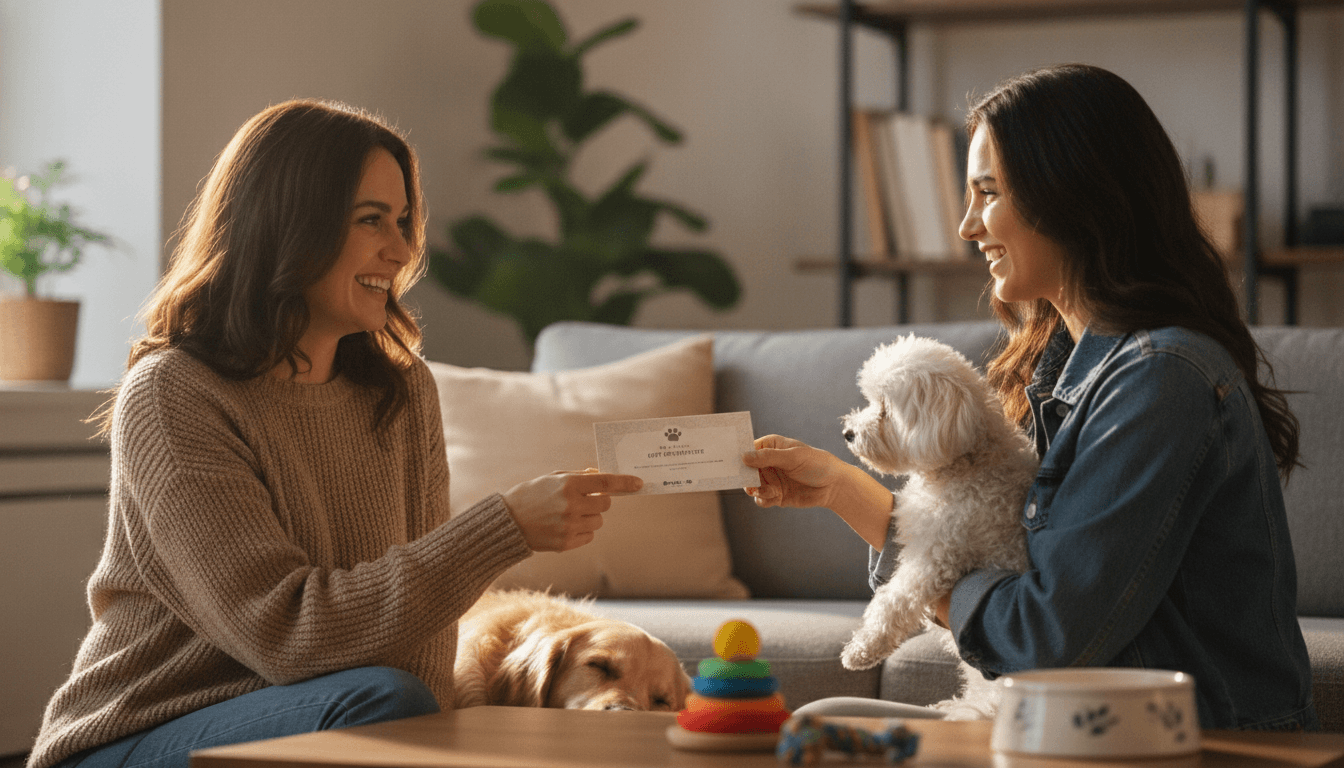
Gift certificates are one of the most under-utilised growth tools in the pet industry. When a client gives your gift certificate to a friend or family member, they're doing something incredibly powerful: they're lending you their trust. The recipient arrives not as a cold prospect but as someone pre-endorsed by a person they trust. Their likelihood of converting into a regular client is dramatically higher than any cold lead.
Why Gift Certificates Are Pure Profit-Positive Growth
Every gift certificate sold is immediate cash in hand. You receive payment upfront and deliver the service later — improving your cash flow. There's no discount involved (the purchaser pays full price), so your margin on redemption is full rate. A portion of gift certificates will go unredeemed (industry average is 10–20%) — meaning you receive payment but never deliver the service. And the redeemed ones bring in new clients who may stay for years.
Few marketing investments deliver this combination of immediate cash, full margin, new client acquisition, and zero upfront cost. Gift certificates should be prominently promoted — not buried as an afterthought.
When and How to Promote Gift Certificates
Christmas and the holiday season is the biggest gift certificate window for pet businesses, but it's far from the only one. Mother's Day, Father's Day, birthdays, and "new puppy" occasions are all strong triggers. Position gift certificates as the answer to "what do you get for the person who has everything?" — especially when that person has a pet they adore.
Keep gift certificates visible year-round: displayed at your counter, promoted on your website booking page, featured in your email newsletter, and available for instant digital purchase. Physical gift certificate cards feel premium and giftable; digital versions sent via email are convenient and immediate. Offer both if you can.
Train your team to mention gift certificates proactively, especially in the run-up to gift-giving seasons. "We have gift certificates if you're looking for something for a pet-loving friend" is a natural, low-pressure mention that converts surprisingly well when timed correctly.
Gift Certificate Best Practices
Issue in specific values rather than a percentage off — £25, £50, £75, £100 feel like real gifts rather than discount vouchers. Include a branded design that makes the card feel worth giving — a well-designed physical or digital certificate is part of the gift experience. Set a reasonable expiry period (12 months is standard) to manage your liability and encourage timely redemption. Record every certificate issued and redeemed — you need to track outstanding gift certificate liability as a real financial obligation.
Combining All Four: Building a Retention and Growth Ecosystem
Loyalty cards, referral programs, coupons, and gift certificates are most powerful when they work together as a coordinated system rather than as isolated, unrelated promotions. Here's how they connect:
A new client arrives after redeeming a gift certificate or a first-visit coupon. At their first appointment, they're introduced to your loyalty program and given a referral card. After 5 loyal visits, they earn a reward — reinforcing their habit and deepening their relationship with your business. When they're delighted (which they are, because you've been delivering great service and rewarding their loyalty), they refer a friend. That friend arrives with a referral discount and joins your loyalty program from day one. The cycle continues.
This ecosystem doesn't require a big marketing budget. It requires consistent execution, a genuine commitment to delivering excellent service that clients want to talk about, and a system for tracking and managing the mechanics without letting anything fall through the cracks.
The tracking piece is where most small pet businesses struggle. Paper-based systems can handle a handful of clients but become unmanageable at scale. Digital management — built into your booking and client management software — makes the entire ecosystem operate automatically, freeing you to focus on delivering the service rather than administering the promotion.
Common Mistakes That Make Loyalty and Referral Programs Fail
Even well-intentioned programs fail when the execution is poor. These are the most common reasons pet business loyalty and referral initiatives don't deliver their potential:
Launching without promoting. A loyalty card sitting in a drawer behind the counter, available only to clients who ask for it, will have minimal impact. Every new client should be enrolled from day one. Existing clients should be told about new programs proactively and enthusiastically. If your team isn't excited about the program, your clients won't be either.
Making it too complicated. Programs with complex earning structures, confusing redemption rules, or multiple tiers that clients struggle to understand will be ignored. If you can't explain your loyalty program in one sentence, simplify it. Simplicity drives participation.
Inconsistent delivery. A referral program that sometimes gives the reward and sometimes doesn't, depending on who's working, destroys trust quickly. Systems and training need to ensure that every promise made to a client is consistently fulfilled.
Not measuring results. If you don't track referral sources, redemption rates, and the incremental revenue generated by your programs, you can't optimise them. Run quarterly reviews: which clients are referring? Which coupons are generating repeat business? Which loyalty rewards are most popular? Use this data to improve what's working and fix what isn't.
Discounting instead of rewarding. A loyalty or referral reward should feel like a gift — something unexpected and generous, above and beyond the core transaction. A £5 discount applied automatically at checkout feels administrative. A "Congratulations — you've earned a free groom!" moment with a personal message feels like recognition. The psychology is completely different, and the loyalty it generates is too.
Run Your Loyalty and Referral Programs Seamlessly With GoPetAI
The difference between a loyalty program that drives real retention and one that sits forgotten on a counter often comes down to systems. When your loyalty tracking, referral management, coupon distribution, and gift certificate issuance are all integrated into a single platform — and all connected to your client records and booking system — everything runs smoothly and automatically.
GoPetAI gives pet businesses the tools to run sophisticated retention and growth programs without the admin overhead. Track loyalty points automatically, send referral links to your best clients, issue and redeem digital coupons, and manage gift certificate liability — all from one place, with real-time reporting so you can see exactly what's working.
Your clients deserve to feel valued. GoPetAI makes it easy to show them they are — and to turn that goodwill into the repeat bookings and referrals that grow your business sustainably.
Ready to build a pet business clients love to recommend? Explore GoPet AI today and see how the right tools transform client loyalty into lasting growth.
About the author
Jeremy
Petcare Sales Manager
Passionate about helping pet businesses thrive through technology and innovation.
Ready to streamline your pet care business?
Join thousands of groomers, boarding facilities, daycare centres, and vet clinics using GoPet AI to manage bookings, CRM, POS, and invoicing — all in one place.
- ✓Online booking & scheduling
- ✓Invoicing, POS & payments
- ✓CRM & client management
- ✓Staff, loyalty & analytics
Setup in under 2 minutes · Cancel anytime
Related articles
View all
Why Your Australian Pet Business Needs Online Booking in 2026 (And How to Set It Up)
Read article
How to Get Your First 50 Pet Business Clients With Zero Marketing Budget
Read article