What Features Does Pet Shop POS Software Need? (2026)
What features does pet shop POS software need? Here's the practical checklist: expiry tracking, pet profiles, grooming booking, loyalty, and real costs.

In this article
The fish tanks need a water test, three bags of senior kibble at the back of aisle two expired last Tuesday, and your groomer is double-booked for the third Saturday running because her calendar lives in a different app from the till. No other kind of shop stacks those three problems on one counter. And a generic cash register can't see any of them.
So, what features does pet shop POS software need? Below is the full, practical answer: the eight features that separate a real pet store system from a dressed-up checkout app, the nice-to-haves you can safely skip at first, how the mainstream options stack up, and what the whole thing should cost. By the end you'll know exactly what to demand in a demo, and which features exist mostly to pad a sales deck.
Table of contents
- The short answer: what features does pet shop POS software need?
- Inventory: real-time tracking, expiry dates, and weighted goods
- Pet and customer profiles: the feature that changes everything
- Grooming and service booking built into the POS
- Payments, loyalty, and the checkout experience
- Multi-location and reporting: what to look for as you grow
- eCommerce and the all-in-one shift
- What pet shop POS software actually costs in 2026
- How the mainstream options compare
- A 7-step way to test any POS before you buy
- The standard to hold every vendor to
The short answer: what features does pet shop POS software need?
A pet shop POS needs everything a normal retail POS does, plus a layer only this industry demands: live animals, perishable food, and services under one roof. Here's the checklist that separates a real pet store system from a generic one.
- Real-time inventory across channels: stock levels that update instantly whether you sell at the counter, at a market stall, or through your online store, so you don't sell the last bag of puppy kibble twice.
- Expiry and batch tracking: date-level tracking for food, treats, supplements, and medication, with low-stock and near-expiry alerts. This is the single biggest waste-killer for pet retail.
- Pet and customer profiles: one record linking an owner to every animal they own, with vaccinations, allergies, diet notes, and purchase history attached to the pet, not just the human.
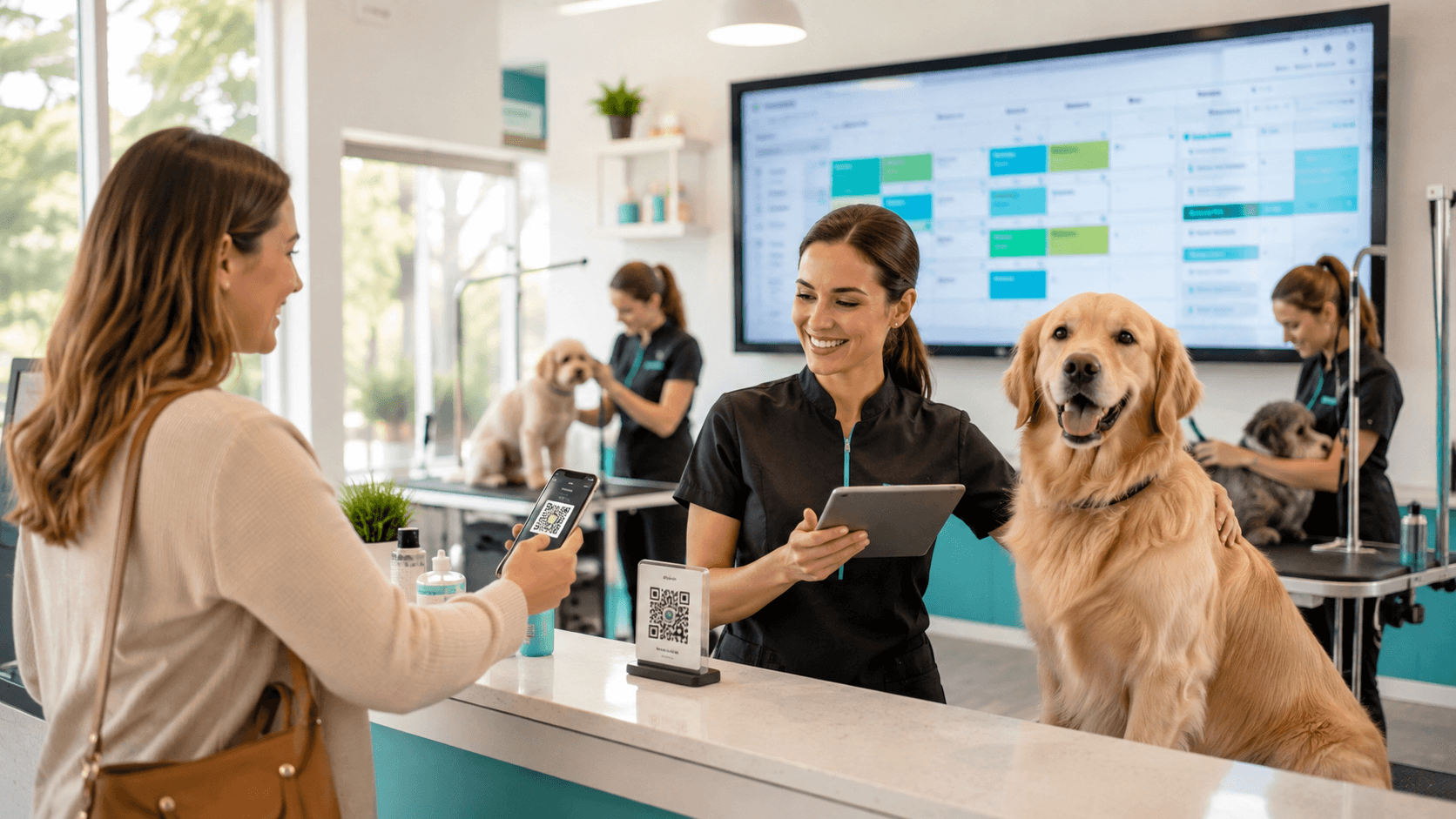
- Grooming and service booking: a calendar built into the POS so appointments, walk-ins, and retail sales all land in one system instead of a separate booking app.
- Weighted and unit-of-measure selling: bulk bin treats, raw food sold by the pound, gravel by the scoop. The POS needs a scale integration and price-per-unit math.
- Loyalty, promotions, and gift cards: points or punch-card rewards tied to pets (not just dollars spent), plus mix-and-match deals like buy-two-get-one on cans.
- Mobile and offline mode: a tablet checkout that keeps selling during an internet outage, and works at adoption events or curbside pickup.
- Reporting that joins products and services: the ability to see that the person buying grooming in March also bought flea treatment, so you can actually act on your data.
If a system you're evaluating hits fewer than six of these eight out of the box, keep shopping. You'll end up bolting on two or three extra subscriptions and paying more than you would have for the right one.
Rule of thumb: if the demo can't show you an expired product report and a dog's vaccination record in under two clicks, it isn't pet software. It's retail software with a marketing page about pets.
Why generic retail POS falls short
Clothing stores don't care what size sweater the customer owns. Pet stores do. A bearded dragon owner and a bulldog owner have almost zero product overlap, and that's where the answer to what features pet shop POS software needs starts diverging from the answer for any other shop. A POS that can't tell those two customers apart can't personalise anything, can't remind anyone about a six-month grooming slot, and can't flag that this specific dog had a bad reaction to a specific treat. Industry comparisons keep landing on the same finding: appointment handling and animal profiles are what most clearly separate dedicated pet systems from standard retail ones. Generic platforms (Square, Clover, Shopify) are excellent cash registers. They just weren't built with a kennel in the back.
Inventory: real-time tracking, expiry dates, and weighted goods
Inventory is where pet stores bleed money, and it's where a proper POS earns its fee.
Real-time, multi-channel stock
You need stock counts that update the moment anything sells, in any channel. Every serious comparison of pet store software lands on this same requirement, mostly because the SKU count in the category gets ugly fast: a mid-sized pet shop easily carries 3,000 to 8,000 SKUs across food, toys, aquatics, small animal, and medication. When half those items also sell online, manual recounting stops being viable. Look for automatic low-stock reorder points per SKU, and purchase order tools that let you raise an order from the screen where you spotted the gap.
Expiry and batch tracking
Pet food and treats are perishable, and medication for the vet corner even more so. Expiry tracking means the system stores a date per batch, warns you when stock approaches it, and lets you discount it automatically. Every expired bag you find at the back of a shelf is money you paid a supplier and never got back. Retail guidance for food-led stores has treated expiry tracking as a must-have for years, and pet shops sit squarely in that category. Ask the vendor: can I run a report of everything expiring in the next 60 days, with batch numbers? If they fumble, walk.
It's no accident that when store owners list what features pet shop POS software needs, expiry tracking is usually the first thing out of their mouths. It's the one feature that shows up as recovered cash in the same month you switch.
Weighted sales and live animals
Two quirks most retail systems choke on:
- Price-per-pound items: raw food, bulk biscuits, substrate, and gravel need scale integration and per-unit pricing that recalculates when the weight changes.
- Live animal records: fish, birds, hamsters, and reptiles aren't inventory in the normal sense. You need a way to log arrivals, track mortality without treating each fish as a $4.99 write-off line item, and record batch-level livestock costs.
Most generalist POS vendors handle weighted goods fine. Almost none handle livestock sensibly. That's a pet-specific system question, not a retail one.
Pet and customer profiles: the feature that changes everything
This is the differentiator. Ask any groomer or store manager who has used both kinds of system, and they'll tell you linked pet profiles with vaccination, allergy, and service notes are the real advantage pet-focused POS has over generic retail tools. I'd go further: it's the feature that makes every other feature work better.
What a good pet profile stores:
- Animal basics: name, species, breed, age, weight, and a photo (staff remember faces, not file numbers).
- Medical notes: vaccinations, allergies, conditions, and vet contact details.
- Service history: every groom, bath, or boarding stay, with notes like "nervous about clippers near hind legs."
- Purchase history: what the owner actually buys, so you can remind them when the 12kg food bag should be running low.
The knock-on effects are where the money is. When the profile holds a groom date, the system can fire a reminder four weeks out. When it holds an allergy, the cashier gets a warning before recommending the wrong treat. When it holds a food bag size and purchase date, you can automate a "time to reorder" message. None of that is possible when the only record you have is "Jane Smith, spent $63.40."
Of everything on the list of what features pet shop POS software needs, this is the one I'd refuse to compromise on. One honest caveat, though: if your shop is purely retail with no services, pet profiles matter less. A food-and-toys-only store can live with customer-level notes. The moment you add grooming, daycare, or boarding, profiles stop being optional.
Grooming and service booking built into the POS
If you run a grooming bath or a self-serve wash out the back, your POS must schedule appointments, and the booking must live in the same system as the till. Two separate platforms means two calendars, double bookings, and staff who hate both. This is also where the question of what features pet shop POS software needs gets sharpest, because booking touches stock, records, and the till all at once.
What to demand from the booking module:
- Staff-level calendars with per-service durations, so a nail trim (15 minutes) and a full groom plus deshed (2 hours) don't block the same slot equally.
- Online self-booking for customers, filtered to groomers qualified for the service.
- Automatic reminders by SMS or email, because no-shows on grooming slots cost real money: a missed 2-hour slot at a $65 average ticket is $65 gone, every time.
- A deposit or card-on-file option to make no-shows less free.
- Retail attach at checkout: when the groom finishes, the same terminal should sell the shampoo used, ring up the service, and update the pet's service history in one transaction.
The industry has already moved this way. Current buying guides treat integrated booking as an expected feature rather than a premium add-on, and the vendors that treat grooming as an afterthought are falling behind. If a vendor tells you to "just use our Calendly integration," that's a no.
Payments, loyalty, and the checkout experience
The front counter still needs to be excellent. Fast, flexible, and boring in the way good infrastructure is boring.
Loyalty that works on pets, not just spend. Standard points-per-dollar is fine, but pet-specific programs do better: punch cards by animal (buy 5 grooms, 6th free), birthday treats per pet, and rewards redeemable on services. Loyalty, promotions, and gift cards are now bundled into paid tiers of most current systems rather than sold separately, so treat any vendor charging extra for basics as overpriced.
Mobile checkout and offline mode. You'll want a tablet you can carry to the fish tank wall, to a curbside pickup, or to an adoption day stand at the local park. Offline capability matters more than people expect: when your broadband drops on a Saturday, an offline-mode POS keeps ringing sales and syncs later, while a cloud-only system turns your counter into a hand-written-receipt operation. That's why offline mode sits near the top of every serious buying guide.
What features does pet shop POS software need at the counter itself? Four checks:
- Card-on-file for grooming repeat customers and deposits.
- Split payments (part cash, part card, part gift card) without the system having a meltdown.
- Vet-family payment plans if you extend credit, which needs clear tracking.
- Tip handling if groomers accept them, with fair distribution rules.
Multi-location and reporting: what to look for as you grow
Single store? You can skip most of this. Two stores or a store plus a grooming annex? Multi-location support becomes a genuine requirement, not a luxury. The bigger you get, the more the answer to what features pet shop POS software needs moves from the counter to the back office.
The multi-store playbook is consistent: you want centralised inventory with stock transfers between locations, chain-wide pricing control (so a sale runs everywhere at once without five manual edits), and a shared loyalty program so a customer earns points at either location. Without those, every new location multiplies your admin work instead of your revenue.
On reporting, the bar is simple. Your POS should answer, without exports and spreadsheets:
- What's my margin by category, because live food margin and accessory margin are wildly different beasts?
- Which services bring in customers who then buy retail, and by how much?
- What's my expiring-stock value trending at this month versus last?
- Who are my top 50 customers by lifetime value, and what pets do they own?
The last one matters more than the rest. Pet retail runs on regulars. Twenty households buying food every six weeks are worth more than four hundred one-off toy sales, and only a POS that knows the household can show you that.
eCommerce and the all-in-one shift
Every serious vendor now pitches all-in-one: retail POS, online store, and service management in a single platform with synced inventory. The shift is real, and it's driven by customers: pet owners expect to reorder food online and pick up in store, so vendors lead with synced stock and integrated booking rather than standalone checkout.
For a small independent shop, don't chase the full e-commerce suite on day one, but do buy a POS that won't fight you when you add it. The expensive mistake isn't launching an online store late. It's discovering your POS has no API and no native store, and migrating everything after two years of data.
It's also where the question "what features does pet shop POS software need?" changes shape. It stops being a checkout question and becomes an infrastructure one.
What pet shop POS software actually costs in 2026
Budget honestly, because the range is enormous. Here's what the market looks like as of 2026:
Tier | Typical price | What you get | Right for |
|---|---|---|---|
Free/basic retail | $0 (payment fees apply) | Checkout, basic inventory, no pet features | Testing the water, market stalls |
Entry pet-capable | from $19/seat/month | Inventory plus limited pet or service tools | Small single-location shops |
Mid-tier | $49 to $69/month | Expiry tracking, booking, loyalty bundled | Most independent pet stores |
Advanced | up to $289/month (software only) | Full service management, multi-location, deep reporting | Busy stores with grooming and boarding |
Custom build | $30,000 to $70,000 per location | Whatever you want, built for you | Chains with unusual requirements |
Custom builds run $30,000 to $70,000 per location, and that figure is worth knowing even if you'd never spend it, because it shows what the genuinely hard problems cost to solve. For nearly everyone reading this, the right spend sits between $49 and $289 per month, with the deciding factor being how much service work you do. Grooming-heavy shops should pay up; pure retail shops shouldn't.
One more way to think about what features pet shop POS software needs: a cheap system that misses the features above is the most expensive option on this list.
Watch the payment processing rates too. A "free" POS with a 3.2% card rate costs a $40,000/month store about $768 more per month than one at 2.3%. The subscription was never the real price.
How the mainstream options compare
Every "best POS" roundup hands you the same five names and moves on. I'd rather tell you where each one actually breaks for a pet shop, because that's the part the roundups skip. Line the five up against the question of what features pet shop POS software needs, and only a couple were designed with animals in mind from day one.
System | Strong at | Weak for pet shops |
|---|---|---|
Square for Retail | Free tier, dead-simple setup, great hardware | No pet profiles, no expiry tracking, booking is a separate product |
Lightspeed | Deep retail inventory, strong multi-location | Pet features come via third parties; pricing climbs fast |
Clover | Solid hardware ecosystem, easy payments | Generic retail DNA; services and livestock are weak |
eTailPet | Built for pet retail, loyalty, groomer tools | Higher cost; implementation takes longer |
GoPet AI | Pet-first profiles, booking, loyalty, POS and records in one | Newer brand, smaller hardware ecosystem than Square |
Square is the most commonly used POS software in the US overall, and for good reason: it's free and it works. But it's a generalist. If your business is grooming-led or carries perishables at volume, a generalist costs you more in lost margin and double bookings than the pet-specific subscription saves. If you're retail-only, small, and price-sensitive, Square is a genuinely reasonable start.
That's where a platform like GoPet AI earns its place: it was built around the pet business model (profiles per animal, service scheduling, loyalty tied to pets, and records that live where the sale happens) rather than retrofitted from general retail. For a store with grooming in the back or boarding on site, that difference shows up in daily operations, not just feature lists.
A 7-step way to test any POS before you buy
Demo scripts hide weaknesses. The demo exists to answer one question, and it isn't "what features does pet shop POS software need?" You already know that part. The real question is whether the vendor can actually deliver it, so make the salesperson do the clicking while you watch.
- The expiry test. Load one product with a batch date, then ask for a report of everything expiring within 60 days. Time them. Three menus deep in the demo means three menus deep in real life too.
- The two-pet household. Create a customer who owns a dog and a cat, sell a product, and see which animal it attaches to. Get this wrong in the demo and reminders will go to the wrong pet for years.
- The booking handoff. Book a groom for 14 days out, then leave it alone. A good system sends the reminder by itself. A bad one waits for your staff to remember.
- The wifi kill. Unplug the internet mid-transaction and see whether checkout keeps running. Watch the salesperson's face during this one; it tells you more than any slide deck.
- The scale. Weigh something on a connected scale and confirm the price recalculates while the number on the display is still settling.
- The joined-up report. Ask, out loud, for every customer who booked grooming last month plus what they bought afterwards. Hesitation here is telling.
- The real price. Get software, seats, card rates, hardware, setup, and post-90-day support costs in writing. Verbal pricing has a habit of growing after the contract is signed.
Any step the vendor can't complete cleanly is a feature you'll miss within your first quarter. Store owners skip the wifi test all the time, and the first stormy Saturday of the season humbles every one of them.
Are pet shops even profitable enough to justify this?
Yes, but not for the reasons on the poster. Food is the heartbeat: the same households come back every five or six weeks whether they like you or not, and the margin on a $70 bag of kibble is thin but relentless. Services are where the money actually sits, because a two-hour groom carries a $65 ticket with almost no product cost behind it.
Demand has never been the problem. US pet owners spend roughly 1% of their income on their animals, and the category runs into the hundreds of billions annually. What quietly kills pet shops is the leak: expired stock written off in the back room, a no-show groom slot nobody resold, the reorder that landed two weeks late because nobody counted the shelf. Expiry tracking, reorder points, and card-on-file deposits exist to plug exactly those leaks. That's the real answer to whether the software pays for itself. It doesn't add revenue so much as stop the bleeding.
The standard to hold every vendor to
Here's the demo I'd insist on before signing anything, run live with your own product list loaded, not the vendor's sample data. One screen that shows a single pet's full history: grooms, food purchases, the allergy note from last spring. One click to an expiry report. One calendar covering both the till and the groomer, so nobody double-books a Saturday again.
If a system does those three things cleanly, it was built by people who understand a pet shop. If it can't, no feature matrix on a website will save it, and you'll be shopping again within two years. Whatever else you take from the list of what features pet shop POS software needs, hold every vendor to those three.
GoPet AI builds exactly this kind of system for pet care businesses: grooming salons, boarding facilities, and vet clinics that need pet records, online booking, POS, loyalty, and business insights in one place rather than stitched together. If you're evaluating a move off a generic POS, it's built for the way pet businesses actually run.
About the author
Jeremy
Petcare Sales Manager
Passionate about helping pet businesses thrive through technology and innovation.
Ready to streamline your pet care business?
Join thousands of groomers, boarding facilities, daycare centres, and vet clinics using GoPet AI to manage bookings, CRM, POS, and invoicing — all in one place.
- ✓Online booking & scheduling
- ✓Invoicing, POS & payments
- ✓CRM & client management
- ✓Staff, loyalty & analytics
Setup in under 2 minutes · Cancel anytime