Performance Evaluation for Groomers: How to Assess, Develop, and Retain Your Grooming Team
Great groomers are the backbone of any grooming business — and keeping them performing at their best requires more than occasional feedback. This guide covers how to build a fair, structured performance evaluation system for groomers that drives quality, reduces turnover, and helps your team grow.
In this article
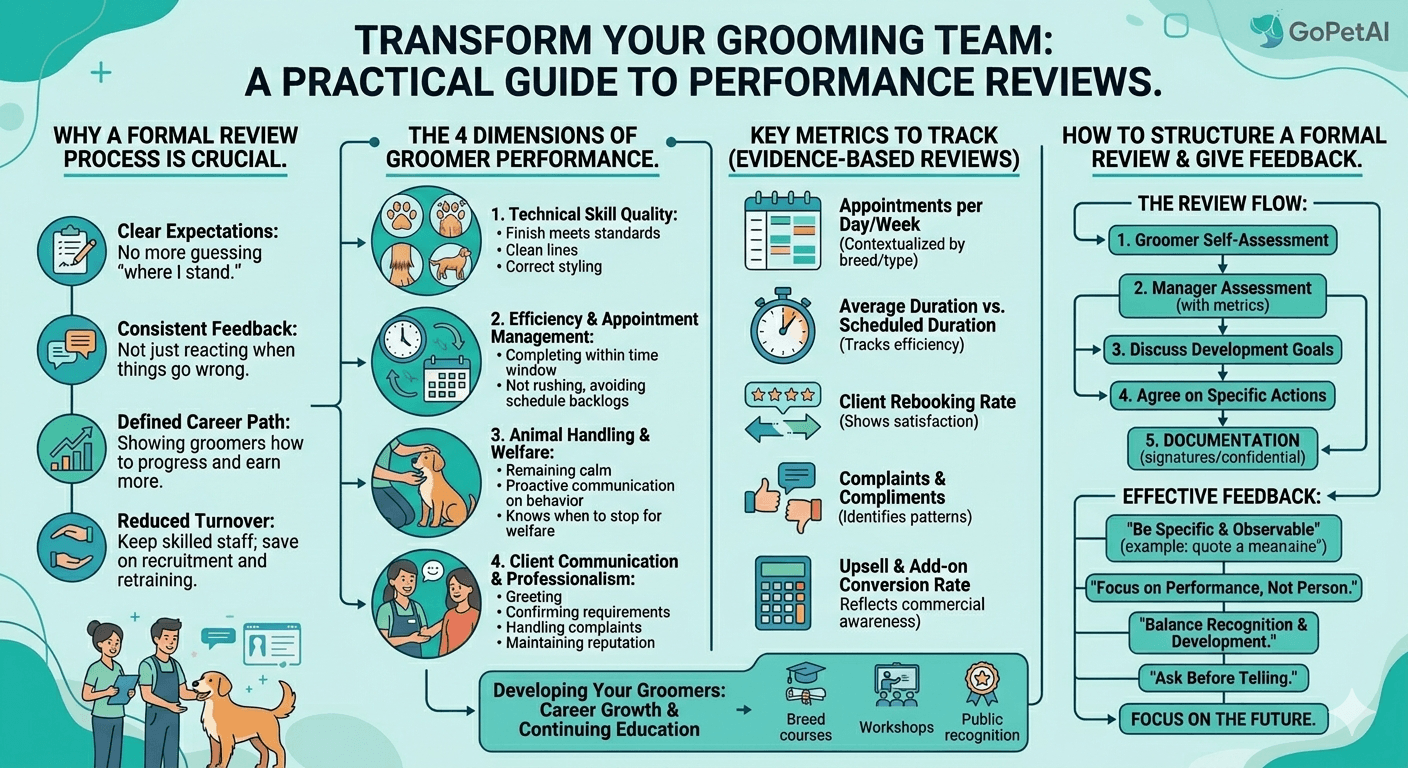
Why Most Grooming Salons Don't Have a Performance Review Process — and Why That's a Problem
Most grooming salon owners are excellent groomers themselves. They know quality work when they see it, they notice when standards slip, and they give feedback in the moment when something goes wrong. What very few of them have is a structured, consistent, documented process for evaluating their groomers' performance over time.
The absence of a formal review process creates predictable problems. Groomers don't know exactly where they stand. Feedback feels inconsistent or reactive — given only when something goes wrong, rarely when things go right. Staff members have no clear picture of how to progress, what it would take to earn more, or whether their career has a future at your salon. The result is disengagement, inconsistent quality, and ultimately the kind of staff turnover that costs grooming businesses thousands of pounds in recruitment, retraining, and lost client relationships every year.
A structured performance evaluation system doesn't require HR expertise or complex paperwork. It requires clarity about what good performance looks like, a fair and consistent process for measuring it, and a genuine commitment to having honest, developmental conversations with your team. This guide gives you the framework to build exactly that.

What Good Groomer Performance Actually Looks Like: Defining Your Standards First
Before you can evaluate performance, you need to define what excellent performance looks like in your salon. This sounds obvious, but most grooming businesses have never written it down. Standards that exist only in the owner's head are impossible to evaluate fairly and impossible for groomers to consistently meet.
Groomer performance breaks down into four distinct dimensions — and a complete evaluation should address all four:
Technical Skill Quality. This is the most visible dimension: the quality of the groom itself. Does the finish meet breed standards (where applicable)? Are lines clean, ears properly attended to, nails trimmed to the correct length? Is the coat in good condition after bathing and drying? Is the styling consistent with what the client requested? Technical quality is assessable through direct observation, before-and-after photos, and client feedback.
Efficiency and Appointment Management. Time is revenue in a grooming salon. A groomer who consistently overruns appointments, creates schedule backlogs, or takes significantly longer than the allocated slot on average appointments is directly reducing your salon's earning capacity. Good performance means completing appointments within the expected time window — not rushing, but not overrunning either. This dimension is directly measurable through your booking system data.
Animal Handling and Welfare. How a groomer handles anxious, reactive, or challenging dogs is a critical dimension that goes beyond skill — it reflects temperament, patience, and professional judgement. Does the groomer remain calm under pressure? Do they communicate proactively with the owner about a dog's behaviour during the appointment? Do they know when to stop a groom for welfare reasons and how to handle that conversation? Animal welfare is non-negotiable, and evaluation of this dimension protects your business as much as it protects the animals in your care.
Client Communication and Professionalism. Groomers are often the primary point of client contact. How they greet clients, how they listen to and confirm the client's requirements, how they manage difficult conversations (a dog that won't be groomed to the original specification, a coat in worse condition than expected), and how they handle complaints all directly affect client retention and your salon's reputation. This dimension is assessable through client feedback, complaint records, and direct observation.
Write these four dimensions down. For each one, describe what below-standard, meets-standard, and exceeds-standard performance looks like in your salon. This becomes your evaluation rubric — the foundation of a fair and consistent review process.
The Key Performance Metrics Every Grooming Salon Should Track
A strong performance evaluation is grounded in data, not just subjective impression. The following metrics give you an objective picture of each groomer's performance over time — and make your reviews much easier to conduct fairly:
Appointments completed per day / per week. The baseline productivity measure. How many appointments does each groomer complete on an average working day? Significant variation between groomers of similar seniority, or significant variation in the same groomer over time, is worth exploring. Note that this metric needs to be contextualised by appointment type — a groomer handling primarily giant breeds will naturally complete fewer appointments per day than one handling small breeds.
Average appointment duration vs. scheduled duration. How often does each groomer finish on time, over-run, or finish early? Consistent over-running suggests either inefficiency, underestimated scheduling times, or genuinely more difficult animals. Consistent early finishes might suggest rushing. This metric is trackable directly from your booking system — it's one of the clearest quantitative measures of efficiency available.
Client rebooking rate by groomer. When a client books with a specific groomer repeatedly, it's a strong signal of satisfaction. When clients book once with a groomer and don't return — or specifically request a different groomer at their next visit — that's a signal worth investigating. If your booking system captures groomer-specific rebooking data, this becomes one of your most powerful performance indicators.
Client complaints and compliments by groomer. Track every complaint and compliment, noting which groomer was involved. A single complaint tells you little. A pattern of complaints about the same groomer — whether about groom quality, handling, or communication — is meaningful management information. Equally, a groomer who consistently generates compliments and five-star reviews is performing above standard and deserves recognition.
Upsell and add-on conversion rate. Does the groomer mention and sell add-on services (teeth brushing, nail grinding, de-shedding, paw balm) where appropriate? This metric reflects both commercial awareness and confidence in client communication. A groomer with a consistently higher add-on rate is generating more revenue per appointment and demonstrating genuine client engagement.
No-show and late cancellation handling. How groomers handle appointment gaps — whether they use the time productively, communicate any issues promptly, or let gaps create operational problems — is relevant to their overall performance profile, especially for senior or semi-autonomous team members.
How to Structure a Groomer Performance Review
With your standards defined and your metrics tracked, the review itself is a structured conversation — not a judgment session. Here's a format that works well for grooming salons of any size:
Frequency. New groomers (in their first 3–6 months) should be reviewed monthly. This allows early course-correction and gives them regular reassurance and direction during a critical development period. Established groomers should be reviewed formally at least twice a year — quarterly is better. Informal check-ins (brief, 10-minute conversations about how things are going) should happen monthly regardless of tenure.
The Review Structure. A formal review should follow a consistent structure every time it's conducted. Start with self-assessment: ask the groomer to reflect on their own performance since the last review. What do they feel they've done well? What do they feel they could improve? This surfaces the groomer's own perspective before you share yours, and often reveals self-awareness (or lack of it) that's valuable information for the conversation.
Move to your assessment: share your observations across each of the four performance dimensions, supported by the metrics you've tracked. Be specific. "Your rebooking rate has improved from 68% to 79% over the past quarter — clients are clearly responding well to your work" is far more useful than "you've been doing better." Similarly, "I've noticed you've been running 15–20 minutes over on large breed appointments fairly consistently — let's talk about what's happening there" is more actionable than "your time management needs work."
Discuss development goals: what does the groomer want to work on or achieve in the next quarter? Is there a breed specialisation they want to develop? A technique they want to master? A qualification they want to pursue? Tying development goals to the review makes it feel like an investment in the groomer's future, not just a management exercise.
Agree on specific actions: both yours and theirs. Maybe you'll arrange additional training for a specific technique. Maybe they'll aim to mention add-on services to every client over the next month. Specific, agreed actions — with a clear timeline and a review point — give the conversation impact beyond the meeting itself.
Documentation. Always document your reviews. A simple written record — the date, the key discussion points, the agreed actions, and both parties' signatures — protects you legally, provides continuity if management changes, and gives the groomer a reference they can return to. Keep these records confidential and stored securely.
Giving Feedback That Actually Changes Behaviour
The quality of your feedback determines whether a performance review changes anything. Feedback delivered poorly — even if the underlying content is accurate — creates defensiveness, resentment, and no improvement. Feedback delivered well creates insight, motivation, and genuine development.
Be specific and observable. Feedback based on specific, observable instances is far easier to accept and act on than vague generalisations. "Last Tuesday, when Mrs. Carter's spaniel came in, the ear trim was uneven on the left side — I'd like to talk about what happened there" is actionable. "Your finishing isn't always consistent" is demoralising and unactionable.
Separate the performance from the person. "The finish on that Bichon wasn't to our standard" is a statement about a piece of work. "You're sloppy" is a statement about a person. The first invites improvement; the second invites defensiveness. Keep feedback about behaviours and outcomes, never about character or identity.
Balance recognition with development. If you only ever give critical feedback, your team will dread reviews and tune out the content. Genuine, specific recognition of things done well — not generic praise, but specific acknowledgement of specific good work — makes critical feedback much easier to receive. The goal is a balanced, honest picture, not relentless criticism or hollow cheerleading.
Ask before telling. Before giving your analysis of a performance issue, ask the groomer what they think happened. Often they already know — and their self-awareness means your feedback lands as confirmation and support rather than criticism. If they don't know, your feedback provides new insight. Either way, asking first produces a better conversation.
Focus on the future. The purpose of feedback is not to relitigate the past but to improve the future. For every performance issue raised, the conversation should move quickly to: what would better look like? What support is needed? What will we do differently? A review that ends with clear forward commitments is far more valuable than one that ends with an exhaustive post-mortem of what went wrong.
Managing Underperformance: When Reviews Reveal a Serious Problem
Most performance reviews will be developmental — identifying areas of strength and growth opportunity in broadly capable groomers. Occasionally, however, a review reveals something more serious: persistent quality issues, welfare concerns, client complaints that cross a threshold, or behaviour that affects the team or the business.
When this happens, the conversation needs to be clearer and more formal. Be honest about what you're seeing: "I need to be direct with you — the level of complaints we've received about your grooms over the past two months is not acceptable, and we need to address it seriously." This is not unkind. It's fair, clear, and gives the groomer the information they need to understand the gravity of the situation.
Agree on a specific improvement plan: defined targets, a clear timeline (typically 4–8 weeks for a formal improvement period), and explicit consequences if the targets are not met. This plan should be documented, signed by both parties, and reviewed at the agreed point.
Support is part of the process. An improvement plan isn't just a threat — it should include whatever genuine support you can provide: additional training, closer supervision, reduced caseload while skills are rebuilt. The goal is improvement, not exit. Exit is the outcome only if genuine support and a fair opportunity for improvement hasn't worked.
Always seek legal or HR guidance for formal performance management processes. Employment law varies by country and situation — in the UK, Australia, and most common markets, there are specific requirements around fair process, documentation, and notice that you need to follow.
Developing Your Groomers: Turning Performance Reviews Into Career Growth
The best use of a performance evaluation system isn't catching underperformance — it's developing the talent you already have. Groomers who feel invested in, who see a clear path for growth, and who are actively developing their skills are far less likely to leave, far more likely to deliver excellent work, and far more valuable as advocates for your business.
Use reviews to map a development path for each team member. What skills do they want to build? What qualifications are relevant to their growth? Could they move toward senior groomer, lead groomer, or salon manager roles over time? Even if your salon is small and the hierarchy is flat, giving groomers a sense of professional progression within their craft — mastering new breeds, developing specialist techniques, becoming the go-to person for anxious or reactive dogs — creates a growth narrative that keeps people engaged.
Invest in continuing education. Breed-specific grooming courses, animal behaviour workshops, first aid training, and competitive grooming events all develop skills and signal that you take your team's professional development seriously. A groomer who has just learned a new technique or returned from a workshop is energised, engaged, and more committed to the team that supported their development.
Recognise progress publicly. When a groomer masters a challenging breed, earns a qualification, or receives a particularly glowing client compliment, acknowledge it in front of the team. Public recognition is a powerful motivator — and it creates a culture where excellence is noticed and celebrated, not taken for granted.
Using Technology to Make Performance Management Easier
Tracking groomer performance metrics manually is time-consuming and error-prone. Booking systems, client management platforms, and salon management software can automate much of the data collection that underpins a strong evaluation process — freeing you to focus on the conversations rather than the spreadsheets.
When your booking system automatically tracks appointment durations, groomer assignment, rebooking patterns, and client feedback, you have a real-time picture of each groomer's performance without having to manually compile it before every review. You can spot patterns as they emerge — a groomer whose over-runs are increasing, a sudden uptick in complaints, a client retention rate that's improved significantly — and respond proactively rather than reactively.
Client review and feedback tools integrated with your booking system make it easy to collect post-appointment feedback at scale. When feedback is collected systematically and linked to specific groomers and appointments, it becomes reliable management data rather than anecdotal impressions.
Staff scheduling and performance dashboards give you visibility across the whole team — identifying who's consistently meeting targets, who needs support, and where your capacity and quality bottlenecks actually are. The result is performance management based on evidence, not gut feel — fairer for your groomers and more effective for your business.
Build a High-Performance Grooming Team With GoPetAI
A structured performance evaluation process is one of the highest-leverage investments a grooming salon owner can make. It improves the quality of your grooms, reduces staff turnover, builds a team culture of accountability and development, and gives you the data to manage your business with confidence.
GoPetAI gives grooming salon owners the operational tools to support every part of this process: scheduling and appointment tracking that captures the data you need, client feedback collection linked to individual groomers, and reporting tools that give you a real-time picture of your team's performance without hours of manual analysis.
Your groomers are your greatest asset. GoPetAI helps you develop them, retain them, and build the kind of high-performance team that clients trust and recommend.
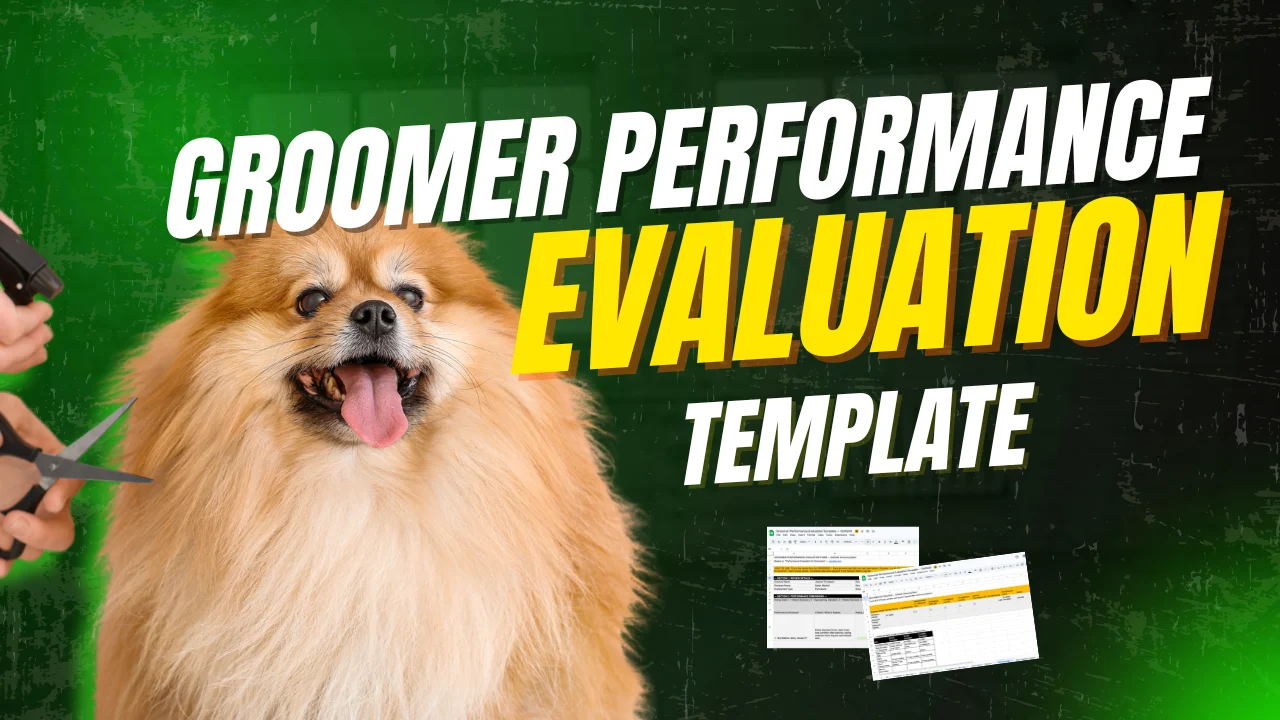 Get Free Groomer Performance Evaluation Template
Ready to build a stronger grooming team? Explore GoPetAI today and see how the right tools support better performance management across your entire salon.
About the author
Jeremy
Petcare Sales Manager
Passionate about helping pet businesses thrive through technology and innovation.
Ready to streamline your pet care business?
Join thousands of groomers, boarding facilities, daycare centres, and vet clinics using GoPet AI to manage bookings, CRM, POS, and invoicing — all in one place.
- ✓Online booking & scheduling
- ✓Invoicing, POS & payments
- ✓CRM & client management
- ✓Staff, loyalty & analytics
Setup in under 2 minutes · Cancel anytime